
Wylie City Directory Collections
Wylie has a useful, but fragmented, historical directory trail. The strongest local digital collection is the Rita & Truett Smith Public Library partnership with The Portal to Texas History. It supplies Wylie and Sachse newspapers rather than a cataloged, complete run of Wylie-only directories. That distinction matters. A newspaper search can confirm a name, street, spouse, school, church, or business between directory dates, but it should not be described as a complete resident roll. The located volumes below are concrete starting points, while the gaps stay visible.
| Collection | Years | Where Held | Access |
|---|---|---|---|
| Wylie-Sachse Newspaper Collection | 1940s-2010s facets, variable issue coverage | Smith Library partner collection at the Portal | Digital browsing and OCR; library contact or local computer fallback |
| Collin County Polk City Directory | 1998 inspected page | Portal to Texas History | Digital page in a broader county volume with Wylie entries |
| Greater Dallas White Pages | April 1981 inspected page | Portal to Texas History | Digital telephone and address reference with regional coverage |
| McKinney and Collin regional volumes | 1878-85, 1902, 1917, 1933, 1938, and selected 1948-85 years | Genealogy, state-library, and area repository leads | Confirm the shelf, catalog, or format before a visit or request |
| Sanborn Fire Insurance Maps | 1901 and 1934 | Library of Congress and Texas map references | Building and street context, not an occupant list |
No official source located a complete publisher-by-year Wylie-only run, a first or last Wylie directory year, or a digitization cutover. Regional substitutes can be valuable, especially where Wylie appears as a town, postal place, railroad settlement, or county entry, but they cannot be turned into a claim of continuous local coverage.
Wylie Newspapers at Smith Library
The Smith Library archive is the practical companion when an exact city directory year is missing. Its Wylie-Sachse partner material has decade facets from the 1940s through the 2010s, and the partner page reports 2,655 Wylie/Sachse items alongside a separate Collin-area count. Search after a directory or deed supplies a surname, address, organization, or business. Obituaries, wedding notices, school items, church references, advertisements, and civic notices may connect a person to a date or place that a directory entry does not explain.
The Smith Library partner page shows the Wylie/Sachse newspaper collection and its holding facets.
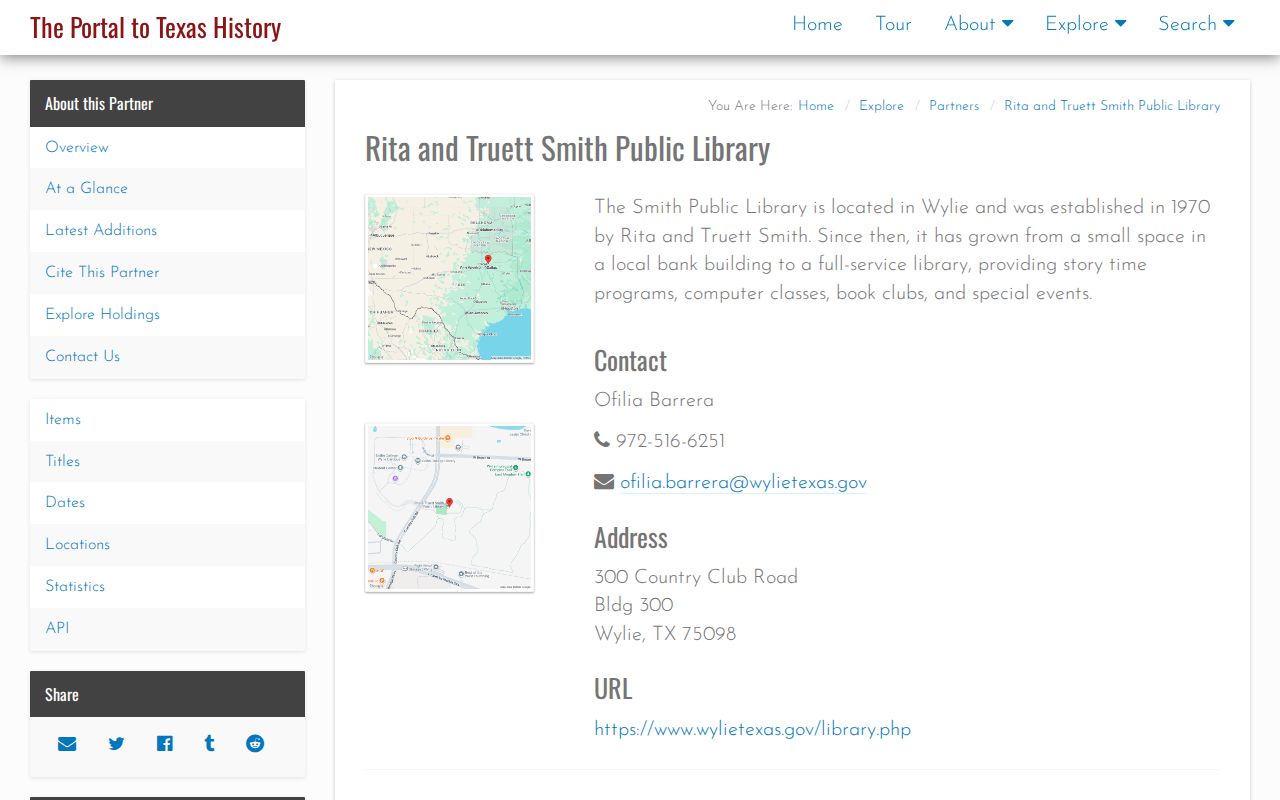
The image points to a research route rather than proof of a complete directory run. OCR can miss names and digits, so inspect the scan and adjacent pages, and try the exact printed street or organization name.
Smith Library is also a physical fallback at 300 Country Club Road. The research record lists public computers, staff help, and interlibrary-loan possibilities. Its listed hours are Monday through Thursday 10 a.m. to 8 p.m., Friday and Saturday 10 a.m. to 5 p.m., and closed Sunday. Ask for a catalog call number, date range, and whether a requested item is digital, on microfilm, or held elsewhere before relying on an old reference.
Note: Collection counts and decade facets identify available material, but do not guarantee every issue or every page survives.
The 1998 Wylie Directory Page
The inspected 1998 Collin County Polk page is direct evidence of how late-twentieth-century Wylie entries can read. Visible entries include Wylie Carpet & Tile Center, Wylie Chamber of Commerce, Wylie Church of Christ, Wylie City Police Department, Wylie City of Public Works, Wylie City Offices, Municipal Court, and Rita & Truett Smith Public Library. The page belongs to a larger Collin County volume, so it is a county directory with Wylie city and business entries, not a separate Wylie-only book.
The linked Polk page displays a scan, page number, and OCR text for the Wylie entries.
Use the scan to verify the OCR. A single line can tie an institution or business to an address, telephone number, role, and sometimes a personal contact, but it does not prove who occupied every nearby property.
| Name line | Uppercase organization, person, or business name as printed. |
|---|---|
| Role or department | Officer, manager, president, vice-president, occupation, industry, or city function when shown. |
| Location | Street address and Wylie marker, printed as (W) on the inspected page. |
| Contact details | Telephone number and sometimes a personal contact name. |
| Page evidence | OCR text and a page-image viewer that should be compared before transcribing a name or digit. |
Read a Wylie City Directory Entry
City directories do not all use the same conventions. The Polk page is business and institution focused, while the 1981 Greater Dallas telephone page is a telephone-directory-style source. The latter places City Hall at 114 N. Ballard, police at 106 S. Ballard, the public library at 108 N. Ballard, Wylie Clinic & Hospital at 103 N. First, and Wylie Feed & Seed at 111 S. Ballard. Those dated lines demonstrate why a present-day address must not be projected backward without checking the volume date.
A complete volume may separate alphabetic listings from a reverse section, and it may place a legend near the front. Photograph or transcribe that legend before interpreting a short mark. A later directory can list an address by street, but that feature was not established for every located Wylie or regional volume.
- Criss-cross directory
- A reverse listing arranged by street address, used to identify the printed occupant or business at an address in that volume. Availability must be checked volume by volume.
- Householder index
- An index that groups a household head or resident name for faster lookup. It can omit other household members and varies by publisher.
- Abbreviation key
- The publisher's explanation for shortened words and symbols. Read it before treating a letter as an occupation, residence marker, or relationship clue.
Note: A directory date usually reflects a publication or fieldwork period, not a guaranteed day of residence.
Wylie Directory Name Variants
Historical search terms need local flexibility. Early Wylie research can include Nickelville, post-office terms, nearby rural routes, survey names, and railroad language because the town developed around the railroad in the 1880s. In digitized text, OCR can turn Wylie into Wiley, Wyley, Wyly, or another close form. A 1956 Dallas directory explicitly directs readers to check Wylie with Wiley, Willie, and Wyley. That is a reason to search variants, not a reason to merge unlike names without seeing the scan.
Use a surname with each place variant, then compare the printed address, organization, and date. The 1886 railroad move and later address changes make a bare city label too weak to establish continuity. A local newspaper item or a deed legal description can supply the missing context.
Regional Directory Volumes for Wylie
When Wylie does not appear as its own heading, the located regional material provides a controlled fallback. The list includes McKinney Business Directory years 1878-79 and 1884-85, a 1917 McKinney Telephone Company Directory, Daily Gazette's Directory of McKinney for 1902, McKinney directories for 1933 and 1938, Collin County business and McKinney-Con Survey directories from 1948 through selected years ending in 1977, and city directories for 1982, 1984, and 1985. The Texas State Library and Archives genealogy guidance is the fallback for city directories, county microfilm, family histories, and catalog research.
These regional runs may list Wylie as a county section, a business destination, or not at all. Search the place name, surname, and street separately. If a catalog points to a physical volume, verify the repository and requested format instead of assuming it can be downloaded or borrowed.
A county-oriented supplement is Collin Chronicles, which has 138 digitized items across five decades of county history, family material, newspaper abstractions, and cemetery content. It can supply family context, but it is not a substitute for a directory entry.
Wylie Directory Dates and Addresses
Institutional addresses create useful date checks. The library began in 1970, moved into a Thomas Street building in 1985, and opened its present Country Club Road facility in March 2010. Meanwhile, the 1981 telephone page records Ballard and First Street locations, and the 1998 Polk page captures later municipal and library references. An address change in these sources can therefore reflect an institutional move, rather than a mistake in the directory or a personal relocation.
- 1878-1917: Located regional business, city, and telephone directories offer the earliest directory-style leads.
- 1901 and 1934: Sanborn references preserve building-footprint checkpoints for Wylie.
- 1981: The Greater Dallas White Pages supplies inspected Ballard and First Street institutional examples.
- 1998: The Collin County Polk page supplies inspected Wylie city, business, and office entries.
- 2010: The present Smith Library building opened on Country Club Road.
No source located a citywide street-renumbering or renaming chronology. Treat a similar street number as a lead only, then join the evidence through maps, legal descriptions, plats, date-specific office listings, and newspaper wording such as “formerly.”
Trace a Wylie Directory Household
A family-history search becomes stronger when the directory sequence is paired with land and census evidence. Begin with a current situs address, parcel identifier, and legal description from CAD or city GIS, then use the Collin County deed index to locate earlier owners. An old street number alone may fail where Wylie was described through rural routes, post offices, or railroad references. The legal description is the more durable bridge between a modern parcel and older records.
- Search the surname and street in the nearest located Wylie, Collin County, McKinney, Greater Dallas, and telephone-directory material.
- Read the entry exactly, including address, spouse notation, occupation, employer, unit, telephone, and any abbreviation key.
- Check the next available year or regional substitute, recording both the printed text and the source date.
- Pair each directory year with the nearest federal census. A directory can place a person near a date, while the census records household composition on its enumeration date.
- Use newspapers between volume dates for sale notices, weddings, obituaries, school items, church notices, and public meetings.
- Confirm an address transition with the parcel legal description, plat, or deed before treating it as the same place.
A disappearance may mean a move, a death, an unlisted household, a changed name form, or a volume gap. It does not prove any one of those outcomes. Once a historical identity needs present-record confirmation, use the dedicated Wylie resident lookup route rather than treating a directory line as current proof.
Sanborn Context for Wylie Listings
Library of Congress Sanborn guidance supports searches by city, edition date, sheet, notes, and digital availability. The located Wylie references are 1901 and 1934. A Sanborn sheet can help test whether a structure existed, its approximate footprint and use, and the period street or house-number context. It cannot identify an occupant, so it belongs beside a directory, deed, plat, and newspaper rather than in place of them.
The most reliable city-directory conclusion is often modest: a person or institution appeared at a printed address in a particular source at a particular time. Preserve that narrow statement, record the page, and let the next source either support it or show a different date-bound result.